











Anti-Counterfeiting Trade Agreement / ACTA
NOTE: This entry is not to be confused with the U.S. intellectual property bills "Stop Online Piracy Act" or "Protect Intellectual Property Act."
Overview
The Anti-Counterfeiting Trade Agreement (ACTA) is a proposed trade agreement that aims to establish international conventions on enforcing intellectual property rights. It would establish an international legal framework for national governments to join voluntarily and create a governing body outside existing decision-making bodies such as World Trade Organization (WTO), the World Intellectual Property Organization (WIPO) or the United Nations. ACTA enjoys widespread support from the producers of music, movies and a range of goods enjoying copyright protections.
Background
Initiated in 2006, the treaty proposal was drafted through a series of multi-party negotiation among governments of nations representing Canada, the European Union, Switzerland, Australia, Mexico, Morocco, New Zealand, the Republic of Korea and Singapore. In addition to government officials, a committee of multinational corporations including the International Intellectual Property Alliance and Pharmaceutical Research and Manufacturers of America was consulted during the negotiation process.
Described by the involved parties as a response "to the increase in global trade of counterfeit goods and pirated copyright protected works," ACTA would set a number of legal enforcement measures against counterfeit goods, generic medicines and copyright infringement on the web.
Signatures
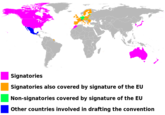
ACTA began acquiring signatures on October 1st, 2011 at a signing ceremony in Tokyo, Japan.[16] On that day, the United States, Australia, Canada, Japan, Morocco, New Zealand, Singapore, and South Korea each signed the treaty. On January 26th, 2012, the European Union signed the treaty, with all but five member states signing as well. The countries that were not included, Cyprus, Estonia, Germany, Netherlands, and Slovakia, are expected to sign it in the coming months. Though the EU as a whole has signed ACTA, it will not be enacted until a debate is held in the European Parliament, which is currently scheduled for June 2012. The final date for countries to add their signature is March 31st, 2013.
Notable Developments
The negotiations took place under state secrecy, although some details of the proposed treaty have been leaked through Wikileaks and other news publications in 2008, 2009 and 2010. The first official version of the draft was published on April 20th, 2010 and November 15th, 2010 and the final text was published on April 15, 2011. A total of 8 participating nations have signed ACTA: Australia, Canada, South Korea, Japan, New Zealand, Morocco and Singapore.
Online Reaction
In June 2010, a conference held at the Washington College of Law with over 90 legal experts concluded "that the terms of the publicly released draft of ACTA threaten numerous public interests, including every concern specifically disclaimed by negotiators." Furthermore, a group of 75 law professors signed a letter to U.S. President Obama demanding that ACTA be halted and changed. The Electronic Frontier Foundation (EFF) also publicly came out against the treaty, calling for more public scrutiny of the proposal.
Protests in Poland
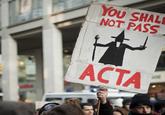
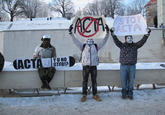
On January 19th, 2012, Poland's Prime Minister Donald Tusk announced that its government would sign the treaty on January 26th. On January 23rd, it was reported that Polish-language social sites Demotywatory.pl, JoeMonster.org, Kwejk.pl, AntyWeb.pl and Wykop.pl were planning a blackout protest against the signing of ACTA, inspired by the success of Wikipedia's partial blackout against the legislation of SOPA and PIPA. On the same day, hundreds of people opposing the signing of the treaty participated in a street demonstration in Warsaw while several popular websites voluntarily went offline or displayed statements regarding ACTA. Approximately 15,000 protestors gathered in Krakow, 5000 in Wroclaw, and thousands more scattered across other Polish cities.[15]


Prime Minister Donald Tusk insisted that his government will not give in to the protesters and that he will sign the international agreement. "There will be no concessions to brutal blackmail," Tusk said at a news conference. Another statement by government spokesperson Pawel Gras became a subject of parodies when he commented that the outage may have been due to increased level of interest in the targeted sites, rather than deliberate attacks.
Anonymous Retaliation
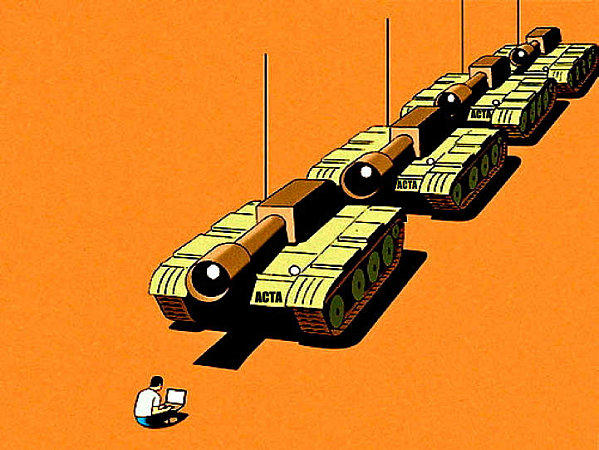
Within the next 48 hours of the announcement, a number of Polish government websites including homepages of the President, the Polish Ministry of Culture and Parliament were brought down by denial-of-service attacks. The hacktivist collective Anonymous claimed responsibility for the attacks in a list of targeted websites released on Pastebin, as well as messages posted via @AnonymousIRC, @AnonymousWiki and @AnonOps.
@AnonymousIRC: "'Internet censorship is wrong' #Anonymous #ACTA,
bq. @Anonyops: "This way to the world war web. Single file, please. #SOPA #ACTA #FBI".
Some of targeted websites were vandalized with a parody video of Poland's Communist-era leader Wojciech Jaruzelski's historic announcement of martial law in December 1981. The hackers also claimed that the password and login to premier.gov.pl's admin panel were "admin" and "admin1" respectively.

Meanwhile, Iowa Senator Chuck Grassley’s Twitter account was reportedly hacked by an individual claiming to be affiliated with Anonymous on January 23rd, only days after the controversial U.S. copyright bills were indefinitely shelved following massive protests. According to a message posted on Grassley’s official Twitter account:

Online Petitions
On 18 February 2012, a petition at jestemprzeciwacta.pl seeking referendum in Poland had reached more than 415,300 signatures. A similar world-wide petition at Avaaz.org collected over 2.5 million signatures since 25 January. A petition directed at United Kingdom citizens, hosted by the UK Government's website, has reached over 14,500 signatures as of 18 February. A petition directed at Estonian citizens has reached over 7,200 signatures as of 18 February.
In the United States, several ACTA-related White House petitions have been created. One petition, "End ACTA and Protect our right to privacy on the Internet," was created 21 January 2012 and has reached the threshold of 25,000 signatures within a month's time. With over 47,410 signatures currently, this petition remains "active" as of 30 May. Another petition, "Please Submit ACTA to the Senate for Ratification as Required by the Constitution for Trade Agreements," was created 22 January 2012 and did not reach the threshold of 25,000 signatures within a month's time. With about 12,850 signatures logged at month's end, this petition was "expired" as of 21 February.
February 11th Protests
After the successful internet blackout protests of SOPA and PIPA, the global activism group Access[9] decided to assist Europeans in organizing both physical and virtual protests on February 11th, 2012. News of the event spread on The Next Web[10] and Geekosystem.[11] Access has organized Facebook events[12] for protests in over 80 cities[14] on a Google map, with some of these events encouraging protesters to bring signs and free candy.[13]
View ACTA Protests Worldwide in a larger map
During the protests in Budapest, Hungrary on February 11th, 2012, photos emerged of a sign printed to appear as if it were a Microsoft Windows warning held by two people wearing Guy Fawkes masks. On February 15th, 2012, a photo was submitted to the media remix site Canvas[17] followed by several edited versions of the photo. The thread was subsequently mentioned in a post on The Daily Dot.[20]


On February 13th, a My Little Pony: Friendship is Magic themed poster from the protests was submitted to the site My Little Brony[21] Cheezburger website.

The EU Review Process
Although the treaty has been signed by 22 of the 27 EU states, the document must be approved by the EC in ordr to become European law. On February 22nd, 2012, the European Commission referred the treaty to the European Union's highest court in order to review its compatibility with the existing EU laws. The question read: "Is the envisaged Anti-Counterfeiting Trade Agreement compatible with the Treaties and in particular with the Charter of Fundamental Rights of the European Union?" As of June 2012, the European Court of Justice's investigation of the agreement remains in progress.
ACTA Stakeholder's Hearing at the EU Headquarters on April 11th, 2012
Through May 2012, a number of EU committees expressed their concerns over the treaty, including a 20-page document detailing the shortcomings of ACTA released by the European Data Protection Supervisor and rejections from the Union's Legal Affairs, Civil Liberties and Development committees. According to the news analysis, the firm decline of the committees could influence the International Trade Commission's recommendation to the Members of the European Parliament (MEPs), who will make the final decision through a voting session that is expected to take place between July 3rd and 5th.
June 9th Protests
With the European Parliament's vote approaching in July, another day of massive protests against ACTA has been organized to take place on June 9th across 120 cities in two dozen countries of Europe and North America. An official Google Map and Facebook events pages were created to help coordinate the demonstrations.
View GLOBAL DAY JUNE 9th 2012: STOP ACTA, SOPA, PIPA, CCI, CISPA, MPAA, RIAA, MPA, ARAA, INDECT, CCDP, DEA, IPRED2, TPP, NDAA, CALEA, FISA, internet ID, censorship, criminalizing people, data retention, surveillance & Co. in a larger map
While the protests will focus on the European Parliament's upcoming vote on the treaty, similar events are expected to take place in cities outside of Europe, including in the United States, Canada and Japan. According to the Daily Dot, the anti-ACTA protest has been also co-opted into the agendas of Occupy Wall Street demonstrators, who have previously spoken out against a number of internet copyright and privacy-related bills, such as SOPA / PIPA and the Cyber Intelligence Security Protection Act (CISPA).
European Parliament Rejects
On July 4th, 2012, Members of the European Parliament[28] formally rejected the international anti-piracy treaty by 478 votes against and 39 votes in favor of the bill (with 165 absentees). The decision, which came less than a month after a number of key EU committees declined to recommend its passage, was instantly covered by mainstream news outlets like the Associated Press[22], New York Times[23] and The Guardian[24], as well as tech news blogs such as Wired[25], WebProNews[26] and ZDNet.[27]


The news was met by polarized reactions from the proponents and opponents of the bill; numerous international entertainment companies and trade associations like Motion Picture Association of America and European Publishers Council decried the rejection while advocates of civil liberties and digital rights hailed it as a "victory for democracy." Some analysts and tech bloggers hastily interpreted the decision as the de facto termination of the pact, considering that the majority of the treaty signatories are member nations of the European Union and no participating government has ratified the pact yet. In stark contrast, EU Trade Commissioner Karel De Gucht stood his ground by releasing a statement that the commission would contest the legitimacy of accusations against ACTA under the arbitration of European Court of Justice before deciding on its future course of actions.

Search Interest
External References
[1] Wikipedia – Anti Counterfeiting Trade Agreement
[2] Electronic Frontier Foundation – What is ACTA?
[3] TechDirt – What is ACTA and Why is it a Problem?
[4] ABC News – Sen. Grassley’s Twitter Account Hacked by SOPA Protesters
[6] Twitter – @AnonymousWiki
[8] F-Secure – Poland Stop ACTA
[9] Access –
[10] The Next Web – 11 February will be a day of protest in Europe against the controversial ACTA treaty
[11] Geekosystem – Protest ACTA on February 11
[12] Google Maps – ACTA Protests Worldwide
[13] Facebook – STOP ACTA – LONDON PROTEST
[14] Facebook – STOP ACTA ! Worldwide protest on February 11 > INVITE YOUR FRIENDS
[15] RT – ACTA action: Poland signs up to 'censorship' as 20,000 rage
[16] Wikipedia – ACTA Signatures and ratifications
[18] Instagram – http://instagr.am/p/G3wUlNTfY7/
[19] Wordpress – Budapest Anti-ACTA protests
[20] The Daily Dot – Canvas makes a meme out of ACTA
[22] Associated Press – EU Parliament rejects ACTA anti-piracy treaty
[23] New York Times – European Parliament Rejects Anti-Piracy Treaty
[24] The Guardian – Acta down, but not out, as Europe votes against controversial treaty
[25] Wired – "European Parliament Kills Global Anti-Piracy Accord ACTA":www.wired.com/threatlevel/2012/07/eu-kills-acta/
[26] ComputerWorld – ACTA treaty not passed in Europe: Victory for evil, evil pirates
[27] ZDNet – ACTA rejected by Europe, leaving copyright treaty near dead
[28] European Parliament – European Parliament rejects ACTA






Top Comments
TheHeroOfDerp
Jan 23, 2012 at 02:06AM EST
Cyber6x Moderator
Jan 23, 2012 at 03:03AM EST