


Twitter / X
About
Twitter, currently rebranding to X, is a social networking[1] and microblogging[2] website where people can share short messages up to 280 (until 2017, just 140) characters long called tweets via a web interface, SMS texting or mobile apps. People can subscribe to other users by following them individually or by following a Twitter list, which are curated by a user and contain a group of different authors. These messages can also be retweeted, which shares the tweet with another person's followers, similar to the Tumblr reblog function. In 2022, the site was purchased by Elon Musk for $44 billion, and he began operating as its CEO in October of that year.
History
The concept behind Twitter was first conceived by Jack Dorsey, who introduced a prototype of the site for Odeo[3] employees. Initially named Twttr, the first message on the microblogging platform was sent out by Dorsey on March 21st, 2006.

After enlisting co-founders Evan Williams and Biz Stone, it was made available to the public on July 15th, 2006. However, the site did not see major traffic until March 2007 at that year's South by Southwest (SXSW) Interactive[4] festival. Since many of the site's early adopters were already headed to the conference, Twitter worked with the SXSW staff to install flat panel screens in the hallways of the main venue.[5] Conference goers could text tweets about the panels they saw to 40404 and see their messages on the screens around the venue.[6]

Hashtag Support
On August 23rd, 2007, Twitter introduced hashtag support, allowing users to interact with a topic as well as person-to-person. While the usage of the number sign (#) in online communications originated with commands in IRC (Internet Relay Chat) networks, Twitter's hashtag function popularized the concept of using the symbol as a way to collect posts across an entire social network, which subsequently became adopted by nearly all major social networking sites, including Facebook, Tumblr, YouTube, Instagram and Google+, among others.

Twitter Redesign
Twitter announced a simplified, streamlined version of the site on December 8th, 2011.[22] The redesign is a complete overhaul of the site[23], offering a new homepage, with videos, photos, and conversations now embedded directly into a user's personal tweet feed. User profiles are also restructured, with the Following and Followers tabs moved away from the tweet feed, which now features embedded videos and images, into a separate section.
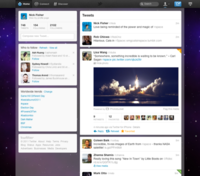

Two new features were also introduced for a user's homepage. The first, Connect, replaces both @ mentions and Activity tabs. The second, Discover, populates hashtag-centric news centered around the users you follow, location information, and global trending topics. Along with the redesign, Twitter announced brand pages, which allows companies to have larger banners as well as the ability to pin a Tweet to the top of their feed.[24][25][26]
Initial Public Offering
On November 7th, 2013, Twitter made its public debut on New York Stock Exchange at the opening price of $45.10 per share, far surpassing the initial public offering price at around $35. Within 10 minutes of the opening, the stock jumped to a peak of $50 per share before stabilizing at about $46 and finishing its first day at $44.90, which gives Twitter a market value of more than $30 billion.

#SaveTwitter Hoax
On August 11th, 2016, the hashtag "#SaveTwitter" began trending as users spread a rumor that the site was shutting down in 2017 due to poor financial standing and its issues with cyberbullying. While the origins of the rumor are unconfirmed, Snopes[79] reported that it may have started when Twitter user @BradTheLadLong used the hashtag #SaveTwitter in a post about cyberbullying on August 10th (shown below).

Shortly after, an image of text that suggested @BradTheLadLong had caused Twitter to shut down in 2017 began circulating (shown below).

It did not help matters that around the same time, Twitter experienced a brief bug where users' follower counts and retweets vanished,[80] nor did it help that on August 8th, BizJournals[81] published an article detailing how Twitter had put their San Francisco office up for sublease, suggesting financial struggles for the company. Snopes theorized that the combination of these events caused the #SaveTwitter rumor to spread, but Twitter has assured the media that there is no truth to the rumor.[82]
Elon Musk's Twitter Acquisition
Elon Musk's Twitter Acquisition refers to events in early 2022 that revolved around Tesla and SpaceX CEO Elon Musk acquiring Twitter which later came to fruition in October 2022. After hinting at buying the company and then being placed on its board of directors, Musk then made moves to buy the website's shares in April 2022 after not joining the board and thories about him attempting an impending "hostile takeover" appearing online.
He then offered roughly $43 billion dollars to buy Twitter, leading to controversy and inspiring reactions and memes across social media. In late April 2022, Musk's offer was accepted by the Twitter board of executives.
Starting on October 7th, 2022, Reuters,[ among other news outlets, reported that Elon Musk had to figure out how to finance the $44 billion takeover of Twitter by October 28th, 2022. At that time, Musk’s financing plan showed that the billionaire still needed to secure $22.4 billion to cover the equity financing portion of his deal. As October 28th approached, Musk was able to fully finance the deal, making up for a $2 billion to $3 billion gap in his financing plan. Experts are currently unsure how he was able to fill the gap.
On October 19th, 2022, Musk tweeted, "I will not let you down, no matter what it takes," in reference to the Twitter deal, gaining roughly 396,500 likes in nine days. On October 26th, 2022, Musk walked into the Twitter headquarters carrying a sink in reference to the "let that sink in" meme. On October 26th, he tweeted a video of the moment with the phrase in tow, gaining roughly 39.7 million views and 1.2 million likes in two days (shown below).
Entering Twitter HQ – let that sink in! pic.twitter.com/D68z4K2wq7
— Elon Musk (@elonmusk) October 26, 2022
On October 27th, 2022, Musk tweeted[54] two screenshots of a long-form answer as to why he bought Twitter (shown below). He captioned them "Dear Twitter Advertisers," in order to address their concerns regarding his motives. In one day, the tweet received roughly 670,200 likes.


Also on October 27th, 2022, Bloomberg[55] reported that Musk had brought in engineers from Tesla to review Twitter's code. They were brought in "so they could assess and explain to Musk what the company needs."
As stated, on October 28th, 2022, Elon Musk officially became the CEO of Twitter.com, reported on by multiple news outlets on the day of. CEO Parag Agrawal and CFO Ned Segal officially left the company in tow. As stated in Bloomberg, Musk was also taking steps towards reversing lifetime bans in his push for "free speech" on the website.
Over the following weeks, Musk tinkered with various aspects of the site, including letting anyone pay $8 a month for a blue, "verified" checkmark. This led to a wave of trolls impersonating notable public figures and companies. The feature was rolled back within days.
Usage
At SXSW, Twitter won the 2007 Web Award[7] and thanked the crowd with an acceptance speech under 140 characters. That year, approximately 5000 tweets were sent per day.[8] In 2008, the amount of daily tweets sent shot up to to 300,000, increasing more than 11,000% to 35 million tweets in 2009. The next year, that number nearly doubled to 50 million.[8] By June 2011, Twitter reported[58] 200 million daily tweets, jumping to half a billion[59] in 2012. These numbers fluctuate from day to day, but the largest amount of tweets occur when large events take place, including celebrity deaths, major sporting events or when big news stories break.
Features
Tweets can be made with up to 140 characters. In tweets, several abbreviations are often seen:
RT: Retweet. Used when manually repeating the same tweet as someone else.
MT: Modified Tweet. Used when manually retweeting, but altering the original text.
OH: Overheard. Used when posting something you overheard.
HT: Heard Through. Similar to OH, often used to credit the person who tipped the user off to the content.
Additionally, there are many Twitter-specific functions[12] built into the system including:
@: If @ is posted with a user’s name in a tweet (ex: “@knowyourmeme”), the message will function as a reply to that user. The message can only be seen by people who follow both the person who tweets the @ and the person who receives the @.
#: If # is posted with a word/phrase (ex. “#hashtag”), the word becomes a hashtag. The tweet can then be found by other people who search for that word. It can be used by people who have similar interests or hobbies, but also for temporary phenomena, like in the case of #Дождь
D: If "D" is posted before a user’s name in the form (D+space+username+message), the message will act as a direct message to the other user.
Retweet: Tweets from public users have a "retweet" button which will automatically copy the tweet to the retweeter's timeline. The retweeter cannot edit or alter the original text.
Character Limit
Since the launch of the microblogging service, Twitter has limited tweets to no more than 140 characters. On September 29th, 2015, the technology news blog Re/Code[75] published an article titled "Twitter Considering 10,000-Character Limit for Tweets," reporting that Twitter was working on a new product that would allow users to tweet longer than the 140-character limit. Additionally, the article noted that the company was working on other tweaks to allow longer posts, like removing hyperlinks from the character-count. On January 5th, Re/Code[76] reported that Twitter was "considering a 10,000 character limit" as part of the company's rumored "Beyond 140" product. That day, many users on Twitter reacted to the rumor, posting jokes, praise and criticisms of the possible update. Meanwhile, Gizmodo[77] published an article titled "Calm Down About the Fake 10,000 Character Limit on Twitter," highlighting several tweets expressing outrage about the rumor (shown below).


Also on January 5th, Twitter CEO Jack Dorsey tweeted a statement about the platform's character limit, expressing an interest in allowing users to post searchable text on top of their tweets (shown below).[78] Within 24 hours, the tweet received upwards of 5,100 retweets and 4,300 likes.

Character Increase
On September 26th, 2017, Twitter doubled the amount of available characters in tweets from 140 to 280.[88] Jack Dorsey tweeted the announcement that evening in a tweet that gained over 18,000 retweets and 26,000 likes[89] (shown below).

The move was immediately met with backlash from Twitter users who once again were upset that Twitter had rolled out a new update that they did not feel was necessary. A viral tweet by @brianrbarone[90] edited Dorsey's tweet such that it expressed the same sentiment in less than 140 characters. The tweet gained over 28,000 retweets (shown below).

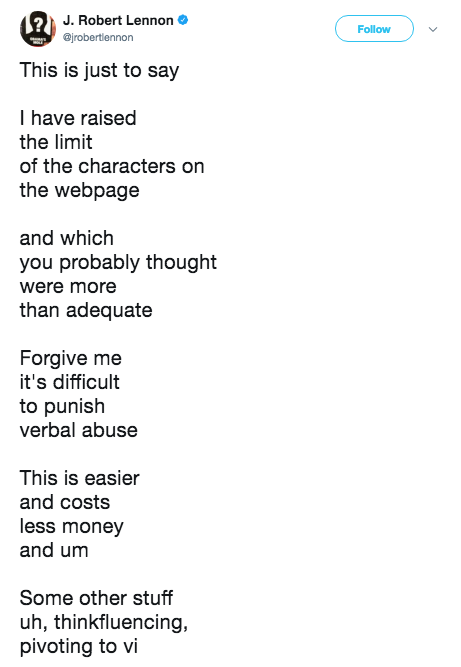
Many mocked the update by using the new character limit for shitposting. A popular form of joke after the update was fitting as much of a copypasta as one could fit into 280 characters (examples shown below).

Some were not as critical of the increase. Buzzfeed[91] pointed out that Japanese Twitter had access to over 140 characters long before this update.
On November 7th, Twitter gave the feature to all of its users, resulting in further backlash.[92] Many Twitter users bemoaned the change as they did when Twitter first experimented with the feature. However, many also utilized the new feature to shitpost by needlessly utilizing all 280 characters for humorous effect. For example, Twitter user @pattymo tweeted a joke about Mr. Belvedere which gained over 680 retweets (shown below, left). Twitter user @hunteryharris uploaded the text from the 2017 Academy Awards Best Picture Gaffe and gained over 6,500 retweets (shown below, right).


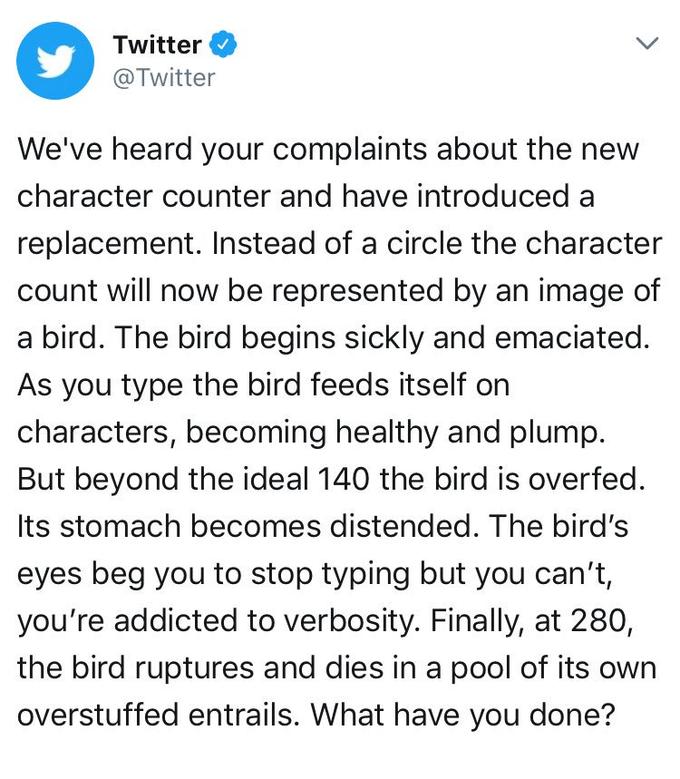
The increase was covered by most major media outlets, including Uproxx,[93] The Daily Dot,[94] Select All,[95] and more. Many Twitter users also complained that the character counter had been replaced with a circle, making it difficult to tell how many characters were in a tweet. Pixelated Boat uploaded a parody of the change that gained 12,000 retweets (shown below). Tweets about the update were shared with the hashtag #280characters.[97]
Meanwhile, on Reddit, a popular post on /r/dankmemes[96] joked about how Twitter's increased character limit would empower Donald Trump, notorious for using his Twitter account. The post by itsameluigia gained over 14,700 upvotes (shown below).

Image Filters
On November 2nd, 2012, the New York Times reported[39] that Twitter would be introducing photo filters to their official mobile applications, according to several unnamed employees. This would allow Twitter users to alter their photos in a similar way to Instagram, without having to direct users and their traffic to the Facebook-owned application. The employees also noted Twitter is exploring adding a video uploader to rival YouTube. The news was also reported by GigaOm[40], Mashable[41], the Verge[42], the Huffington Post[45] and the NextWeb[43] over the next several days. On November 5th, Instagram's CEO Kevin Systrom stated[44] that he has no problem with Twitter adding filters to their image hosting services, noting that "Instagram is a community and not a filter app."
Usage in Military Conflicts
With the growing trend of subscription among governmental agencies, military branches and even paramilitary organizations, Twitter has proven to be a resourceful public channel for official state-level communications and wartime propaganda. Following the Israeli Defense Forces' launch of Gaza Strip military operations in November 2012, usage of Twitter from both the IDF and Hamas' military arm Al-Qassam Brigades was noted by several news publications, including CNN[46], The Telegraph[48] and BBC.[47]
Some of the early examples include:
- In September 2012, Al-Shabaab (@HSMPressOffice link via Wayback Machine), a Somali militant Islamist group with ties to Al Qaeda, launched a propaganda campaign against its enemies via Twitter by portraying the Kenya Defence Forces' intervention as invaders seeking to occupy the African nation. In addition, the group's Twitter account occasionally provided live updates of casualties and outcomes of various assaults.
- In October 2012, Ansar al Sharia, a Libyan extremist group, reportedly claimed responsibility for the attack on the U.S. embassy compound in Benghazi, Libya via Twitter and called on its subscribers to carry out a similar assault on the American embassy in Tripoli. However, the report was later found to be erroneous.
- In November 2012, the Israeli Defense Forces (IDF) announced its launch of military operations against Hamas militants of Al-Qassam Brigades in the Gaza Strip, which was quickly followed by the latter's condemnatory tweet of the IDF's air strike which killed the group's leader Ahmed Jaabari. Both camps have been live-updating their Twitter accounts with the latest developments in the region.
Vine
On January 24th, 2013, Twitter launched the Vine mobile service that allows users to share looping videos at a maximum of six seconds in length. The app was initially released for free on Apple's iOS[49] store, with plans to develop versions for other phone operating systems in the future.[50] Several tech news sites likened the service to a video version of Facebook's Instagram, giving the ability to follow other users and discover content from strangers.

Several Twitter users pointed out that adult-themed content had been uploaded to the service under the hashtags "#porn" and "#nsfwvine."[54] On January 27th, New York Times columnist Nick Bilton published a tweet about how Vine was being used to upload sexually explicit content.
Friend: "So are people using Vine for porn yet?"Me: "Nah, I don't think so."Friend: "Check the hashtag #porn."Both: "Holy ****!"
— Nick Bilton (@nickbilton) January 27, 2013 (via Wayback Machine)
The same day, CNET[51] published an article about the adult content on Vine, noting that it may violate Apple's iOS store terms of service. On January 28th, the Christian Science Monitor[52] reported that one sexually explicit Vine video had been featured on the app's "Editor's Pick" list (shown below), which Twitter claimed was the result of a "human error."

On the following day, CNN[53] published an article noting that searches for "porn," "nude," "sex" and "naked" were no longer delivering any results in the Vine app. The same day, CBC[54] published an article reporting that Twitter had disabled the "#porn" hashtag from search and that a reporting system would place warnings in front of questionable content. While Vine was initially adopted quickly[60], usage declined sharply[61] in mid-June 2013 after Instagram launched video sharing.

Music App
On the morning of April 12th, Twitter partially unveiled its standalone music service with a welcome page featuring the iconic bird logo, the hashtag #music and a sign-in button. Although some of the most important details about the service remained in the dark, several tech and social media news sites[55][56][57] speculated that the mysterious launch event may have had something to do with Twitter's acquisition of We Are Hunted, a music-oriented startup that tracks trends in music based on social media mentions, on the day before, as well as to coincide with the opening weekend of Coachella Valley Music and Arts Festival.

Later that same day, Twitter's music page was updated with a description of a standalone mobile app that recommends artists and songs to users based on its analysis of personalized Twitter feeds, in addition to instant playback feature via third-party services like iTunes, SoundCloud and Vevo. As of July 2013, the Twitter #music app has received a 3.5 star rating in the iPhone App Store.[62]
Threads
On December 12th, 2017, Twitter announced that they were launching an easier way to thread tweets together.[104] With an update, the company said that users will gain the opportunity to tap a "+" button that will connect tweets and post at once. The feature is called "Threads," which makes "tweetstorms" a functional option on the mobile app and site.

Several media outlets covered the update including Wired,[105] The Washington Post,[106] Tech Crunch[107] and more.
Highlights
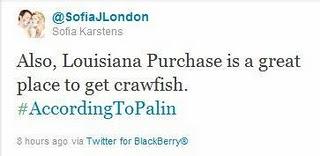
Since Twitter supports trending topics through hashtags, it is easy for an idea to spread quickly on the site. These include (but are not limited to) Pants Status (shown below, left), #дождь, Sometimes I Just Want To Copy Someone Else’s Status and #AccordingToPalin (shown below, right).

Additionally, several memes have been popularized by hashtags like White Girl Problems and First World Problems. There are several sites that track hashtags and other trending topics on Twitter, including Twee.co[13] and What The Trend.[14] Additionally, Twitter is the home of the Fail Whale, which appeared when Twitter was down or over capacity through April 2013.[63]

Anonymous Operations
Twitter has also played a huge role in many Anonymous operations, for example in #OccupyWallStreet and Operation Bart, where Twitter became one of the prime methods of assembly and information dissemination.
Twitter's 2011 Review
On December 1st, 2011, Twitter began publishing a series of videos and infographics with the hashtag #YearInReview[21] on their blog.


TPS (Tweets Per Second) Records[20]
- December 31st, 2010: Japanese New Years Eve / 6,939 tweets per second
- February 6th, 2011: Super Bowl XLV / 4,064 tweets per second
- March 11th, 2011: Tōhoku Earthquake in Japan / 5,530 tweets per second
- May 2nd, 2011: Osama bin Laden's Death 5,106 tweets per second
- July 17th, 2011: Women's World Cup Final / 7,196 tweets per second
- August 24th, 2011: East Coast Earthquake / 5,500 tweets per second
- August 28th, 2011: Beyonce's Pregnancy / 8,868 tweets per second
- December 9th, 2011: Screening of Japanese movie Castle in the Sky / 25,088 tweets per second[27][28]
- January 8th, 2011: Tim Tebow’s 80-yard overtime touchdown pass / 9,420 tweets per second
- February 5th, 2012: New York Giants win Super Bowl XVLI / 10,245 tweets per second[65]
- April 24th, 2012: Champions League match between Barcelona and Chelsea / 13,684 tweets per second[64]
- July 1st, 2012: Spain wins Euro 2012 finals / 15,358 tweets per second[65]
- November 7th, 2012: Barack Obama wins second term in office / 327,000 tweets per second[66]
Criticisms
Censorships
Twitter has censored hashtags on a number of occasions after users complained that they found the them offensive, such as #Thatsafrican, #thingsdarkiessay and #ReasonstoBeatYourGirlfriend among others.
- In China, access to the microblogging service has been blocked intermittently. In the second half of 2009, access to Twitter and Facebook were blocked presumably due to concerns of social and political commentaries and protest organizations during the Ürümqi riots in July 2009. In 2010, Chinese human rights activist Liu Xiaobo became a censored topic on Twitter after he won the 2010 Nobel Peace Prize.
- In Egypt, Twitter was inaccessible in January 2011 during the Egyptian protests. Many news reporters on the site blamed the government for blocking access while Egypt'se mobile network provider Vodafone denied any involvement in the temporary block. In the United Kingdom, British Prime Minister Gordon Brown threatened to shut down the microblogging service in response to the riots in 2011, though it was never implemented.
- In South Korea, the government tried to block access to the Twitter account @uriminzok, which was launched by the North Korean government in August 2010. After acquiring over 9,000 followers in less than a week, the account was banned by South Korea's state-run Communications Standards Commission for broadcasting "illegal information."
#TwitterBlackOut
On January 26th, 2012, Twitter announced in a blog post[31] about a new policy that will allow censorship of its content in accordance with the domestic laws of the countries where it is in service.

The blog post also pointed out that it will take such actions "in response to […] a valid and applicable legal request." Upon processing a complaint, Twitter would notify users in the affected region that they may not see certain content due to specific legal reasons and records of complaints will be publicly available through Chilling Effects' Cease & Desist Database.[34]


With the heightened tension surrounding the issue of online censorship (see: Stop Online Piracy Act and Anti-Counterfeiting Trade Agreement) The decision was met by negative responses on Twitter and elsewhere online, spurring angry #Outrage comments and talks about #TwitterBlackout, a day-long boycott of the service on January 28th. The international free speech NGO Reporters Without Borders also expressed disappointment in a letter[32] to the Jack Dorsey, emphasizing the important role of the service as an organizational tool in repressive countries.
"We urge you to reverse this decision, which restricts freedom of expression and runs counter to the movements opposed to censorship that have been linked to the Arab Spring, in which Twitter served as a sounding board."
The news of Twitter's policy change and the reaction were covered by major daily publications and news blogs across the world. The New York Times[33] described the decision as a "coming-of-age" moment for the company that has quickly matured from a San Francisco start-up to a global communications service.
Reply Update
On March 30th, Twitter updated the way replies are displayed on the platform.[83] According to Twitter, the update will simplify conversations in the following ways:
1. Who you are replying to will appear above the Tweet text rather than within the Tweet text itself, so you have more characters to have conversations.
2. You can tap on “Replying to…” to easily see and control who’s part of your conversation.
3. When reading a conversation, you’ll actually see what people are saying, rather than seeing lots of @usernames at the start of a Tweet.
In essence, usernames will no longer count against Twitter's 140-character limit. However, many users were unhappy with this change for several reasons. Among common complaints are the fact that now users can be tagged in conversations they want no part of and can't back out of.

Others were outraged that Twitter had implemented this feature when other features such as an edit button and abuse continued to go unaddressed by the company.


Furthermore, the update made it such that users with low follower counts would be deemed less important in replies, making some conversations very difficult to read.

2017 Design Update
On June 15th, 2017, Twitter unveiled a new design for the site.[84] The changes include a side navigation menu for iOS, more "consistent" typography, and rounded profile photos, along with some small aesthetic changes.

The redesign was met overwhelmingly with disgust, as users once again pointed out that Twitter seemed to actively be ignoring calls for restricting white supremacist, racist, and Nazi users/content in exchange for unpopular design tweaks. Responses to the redesign were compiled by SelectAll,[85] Uproxx,[86] Mashable,[87] and more.


Twitter Unverification Crackdown
On November 9th, 2017, Vice[98] reported that anonymous sources from Twitter have confirmed that verification had been an ongoing problem with in the company, addressing user complaints about alt-right and/or white supremacist users were being verified. As the article states, after Unite The Right Rally founder Jason Kessler was verified, it "caused many to fault Twitter for tacitly endorsing the ideals he espouses--essentially, white supremacy. The verification process, according to Twitter, is supposed to authenticate a person’s identity. But, instead, it’s created a hierarchy of 'Very Important Tweeters,' or 'VITs,' as they are referred to internally by staff."
That day, Twitter announced that they would be pausing verification until they could solve the issue of perceived bias toward verified users. In a tweet,[99] Twitter Support's account wrote, "Verification was meant to authenticate identity & voice but it is interpreted as an endorsement or an indicator of importance. We recognize that we have created this confusion and need to resolve it. We have paused all general verifications while we work and will report back soon." The tweet (shown below) received more than 12,000 retweets and 21,000 likes in one week.

The following week, Twitter[100] updated their policy, replying to their tweet about verification. Over three tweets (shown below) they wrote, "UPDATE on our verification program and the actions we're taking. Verification has long been perceived as an endorsement. We gave verified accounts visual prominence on the service which deepened this perception. We should have addressed this earlier but did not prioritize the work as we should have. This perception became worse when we opened up verification for public submissions and verified people who we in no way endorse."

Following the announcement, the verification blue checkmark on numerous verified white nationalist and alt-right Twitter accounts were removed, including Jason Kessler, Richard Spencer, Laura Loomer and others. Some of them claimed that they were being "censored." In the response about removal of verification status, Twitter wrote that these accounts did not comply with the guidelines of verification accounts, which include "promoting hate and/or violence against, or directly attacking or threatening other people on the basis of race, ethnicity, national origin, sexual orientation, gender, gender identity, religious affiliation, disability or disease. Supporting organization or individual that promote the above" and "inciting or engaging in harassment of others."
Several media outlets reported on the verification removals, including NBC,[101] Slate,[102] The Washington Post[103] and more.
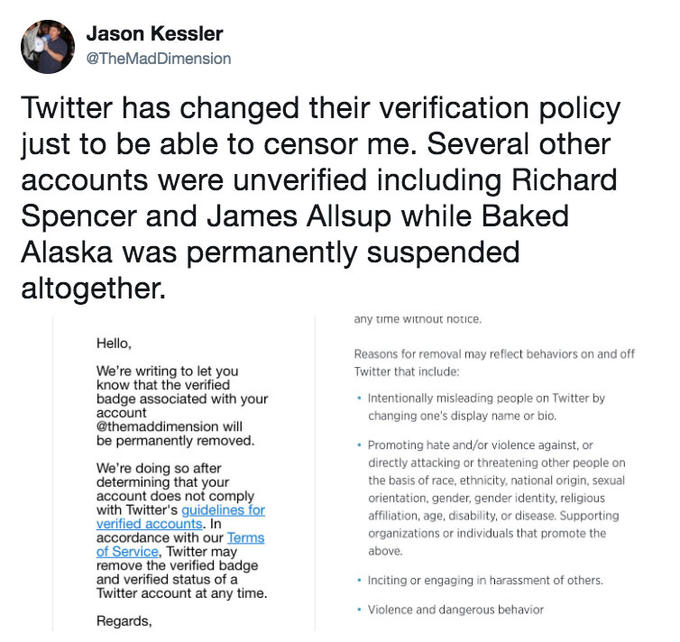


Alt-Right Purge
On December 18th, 2017, in accordance with their updated terms of service released in November 2017, Twitter began banning users within the alt-right, neo-Nazi and/or white supremacist movements. The new terms offer harsher definitions for abuse and hateful conduct, which bans promoting violence against other people on the "basis of race, ethnicity, national origin, sexual orientation, gender, gender identity, religious affiliation, age, disability, or serious disease." Additionally, the company has banned hateful iagery and symbols in profile images and header, as well as the use of usernames, display names and profile bios to "engage in abusive behavior, such as targeted harassment or expressing hate towards a person, group, or protected category."[108]
Some within the movements affected by the purge began tweeting the hashtag “#TwitterPurge” to express their dismay by the enforcement of such rules. Twitter[109] user @jeffgiesea tweeted, “A local bakery doesn’t want to bake me a fabulous gay wedding cake = huge injustice! A monopoly social platform wants to ban me for political views = no prob hooray!” The post (shown below, left) received more than 600 retweets and 1,400 likes within 24 hours.
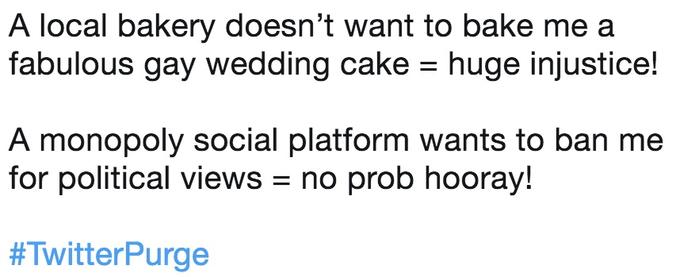
Some of the more high-profile users to be banned includes members of Britain First, the far-rightgroup, which rose to prominence after President Donald Trump retweeted a video of Muslims allegedly participating acts of violence -- those videos were later either discredited or questioned for their authenticity.
Many of the users removed from Twitter during the enforcement moved to the alt-right friendly social media site called Gab.[110]
Jack Dorsey's Defense
On July 20th, 2018, New York Times[112] writer Maggie Haberman announced in a column that she would be leaving Twitter for an extended period of time. In her analysis, she blamed her alienation from the platform on the change in behavior from its users and how the website operates on a technical level. She wrote:
The viciousness, toxic partisan anger, intellectual dishonesty, motive-questioning and sexism are at all-time highs, with no end in sight. It is a place where people who are understandably upset about any number of things go to feed their anger, where the underbelly of free speech is at its most bilious.
Twitter is now an anger video game for many users. It is the only platform on which people feel free to say things they’d never say to someone’s face. For me, it had become an enormous and pointless drain on my time and mental energy.
The article prompted a response from Twitter CEO Jack Dorsey on Twitter.[113] Over a series of tweets (shown below), he responded to criticisms made by Haberman in the article. He wrote:
A few thoughts on @maggieNYT’s article on Twitter. A lot of fair critiques within.
'But the medium has changed. Everyone I follow on the site seems to be tweeting more frequently, so I had to check in more frequently.'
This is the intention behind ranking the timeline. Show you “what matters” first, everything else still accessible. Lots of work still to do.
'On Twitter, everything is shrunk down to the same size, making it harder to discern what is a big deal and what is not. Tone often overshadows the actual news. All outrages appear equal.'
Def a problem. Believe we can help solve by showing more context and related conversation.
This is our primary job: 'To be clear, Twitter is a useful and important platform. It’s a good aggregator for breaking news. I still check my feed to see breaking news developments, and I will continue to.'
Thinking a lot about how to promote more participation in conversation.
Powerful, but only if we help organize and not overwhelm people: 'And it is democratic--everyone gets to have a voice, whether they work for a local paper, a small TV station or one of the biggest newspapers in the world, or are not in the media business at all.'
'The downside is that everyone is treated as equally expert on various topics.'
One of the biggest areas I believe we can help. Helping to determine credible voices per topic in real-time is extremely challenging, but believe it’s possible. Mix of algos and network.
'There is an important discussion about journalism that must take place, including about how all of us performed during the 2016 campaign, but Twitter is not where a nuanced or thoughtful discussion can happen.'
This is what we’d like to fix the most.
Fundamentally, we need to focus more on the conversational dynamics within Twitter. We haven’t paid enough consistent attention here. Better organization, more context, helping to identify credibility, ease of use.
Challenging work and would love to hear your thoughts and ideas.


Jack Dorsey's Improvement Ideas
On August 15th, 2018, the Washington Post[114] published an article after an interview with Jack Dorsey in which the Twitter CEO outlined some ideas he had for improving the site. These included "features that would promote alternative viewpoints in Twitter’s timeline to address misinformation and reduce '"echo chambers":/memes/filter-bubble,'" "labeling bots," and "redesigning key elements of the social network, including the 'like' button and the way Twitter displays users’ follower counts." This came after several weeks of criticism for the way Twitter handled Alex Jones, not suspending him after several other major social networks suspended him (eventually Twitter handed Jones and Infowars a seven-day suspension).
Commentary on the proposed changes ranged from skeptical to supportive. The Daily Dot[115] noted that labeling bots would be a good idea, but fact-checking tweets would be a massive and potentially impossible undertaking, and also noted that Twitter's seeming double-standard for rule-breaking well-known accounts has long frustrated users. Endgadget[116] praised the company for looking at root problems with the site rather than implementing what Dorsey called "band-aid" solutions to the site's issues with hate speech and fake news.
Twitter's users bristled at the idea of "alternative viewpoints" being shown in their timeline. Some users imagined that this would mean they would see more conservative viewpoints in their timeline due to the site's notoriety for giving far-right and white nationalist users a platform. User @TheDweck tweeted a hypothetical of Twitter offering her racist media under the guise of "alternative viewpoints," gaining over 400 liked and 3,200 retweets (shown below, left). User @_zakali tweeted that "alternative viewpoints" would be a euphemism for hate speech and racism (shown below, right).


Academic Research
Several studies have been conducted on Twitter to break down what types of tweets are made and how what people are tweeting represents cycles of human emotion.
"Meformers" vs. "Informers"
Two Rutgers University professors, Mor Naaman and Jeffery Boase, divided Twitter users into two major categories in 2009: "Meformers" (users who tweet about their everyday lives and feelings) and "Informers" (users who use the site to share information and news).[15] 80% of Twitter users fall into the Meformer category, with a median of 61 friends and 43 followers. The median Informer, however, was found to have 131 friends and 112 followers.[16]
The study also broke down tweets into 9 different types:

The study used a sample of 3379 tweets, finding that that 22% of them were under the Information Sharing category and 41% were the Me Now category, bursts of thought about the users life with little to no context.
Pear Analytics
In August 2009, Pear Analytics[17] published a similar report, dividing tweets into six categories:

Pear had a sample of 2000 tweets and found that the most popular category was "Pointless Babble," with 41% of tweets from the sample. The next popular were conversational tweets, with 38% of the sample being in that category.
Happiness During the Day
A study by sociologists at Cornell University published in September 2011 used Twitter to help determine when people are the happiest.[18][19]

Using a sample of over 500 million public tweets made between February 2008 and January 2010, Scott Golder and Michael Macy analyzed tweets by how positive and negative words were used, in addition to emoticons. The found that positive posts peaked daily in the morning and after dinner, with users' overall moods being the lowest at the beginning of the workweek.
Happiness Between 2009 and 2011
In December 2011, researchers at the University of Vermont published a study[29] in which they analyzed patterns of happiness, similar to the Cornell research published earlier that year. However, they looked more at the pattern of how positive words were used over the course of three years rather than just at a workweek. They found that the general happiness of Twitter users peaked in April 2009[30] and has fallen sharply in the past two years. The researchers found that some of the saddest moments in Twitter history have included news of the 2009 swine flu, Michael Jackson's death, Patrick Swayze's death, the ending of LOST and Germany beating England in the 2010 World Cup.

Average happiness on Twitter, charted by the day of the week.
Trend Prediction Algorithm
On October 31st, 2012, a press release from the Massachusetts Institute of Technology (MIT) announced[35] that Associate Professor Devavrat Shah and student Stanislav Nikolov will be presenting an algorithm at the Interdisciplinary Workshop on Information and Decision in Social Networks on November 9th, 2012 that will be able to predict trending topics on Twitter approximately an hour and a half before they will trend. The algorithm was trained by combing through data for 200 topics that did not previously trend and 200 that did, attempting to find meaningful patterns. In action, the algorithm compares the changes of a topic over time with the information from the training sets. When the system was tested on live tweets, the algorithm was able to compare statistics to the patterns of previously trending topics, finding new trends with a 95% accuracy rate. The news was shared on Forbes[36], Mashable[37] and WebProNews.[38]
Evidence of Time Traveling
On January 7th, 2014, Michigan Technological University's physics professor Robert Nemiroff and graduate student Teresa Wilson presented an interesting report about a whimsical study in search of empirical evidence of time-traveling on Twitter.[68] According to the Associated Press, the idea came from an idle chat they had at a Thursday night poker game, during which they hypothesized that if any mentions of "Pope Francis" or "Comet ISON" were to be found in tweets from 2011, it would suggest that someone had gone back in time to reveal hints about the future, thus effectively proving the concept of time-travel.[70]

The research project, which mainly involved searching through Twitter's public archives and search engine queries for any prescient mention of information, found no evidence of time-travelers on the microblogging site. In addition to their online research, Nemiroff and Wilson even challenged the users on Twitter to go back a month in time and tweet something about the future with the hashtag #Icanchangethepast2, which, unsurprisingly, did not turn up any leads.[69]
The Truthy Database
On August 25th, 2014, The Washington Free Beacon[72] reported that the National Science Foundation (NSF), a U.S. federal government agency tasked with supporting fundamental research, education and development in non-medical fields of science and engineering, has been financing the creation of an online database that will monitor, track and catalogue "suspicious memes" circulating on Twitter, especially those relating to "political smears, astro-turfing, misinformation and other social pollution."[73]

click on the image to visit and browse the OSoMe (formerly Truthy) database
Dubbed the "Truthy" database[74], in reference to the Restoring Truthiness rally launched in 2010 by late-night cable pundit Stephen Colbert, the project is currently being developed by a group of researchers at Indiana University with a federal grant of nearly $1 million in budget. According to an official record of the grant on the NSF website[71], the University of Indiana team has so far received $919,917 for the project since its launch on July 1st, 2011. The federal grant is expected to expire on June 30th, 2015.

Interactive visualizations of U.S. political conversation on Twitter


Timeline: Left vs. Right Tweet Sentiment Analysis | Timeline: Left vs. Right Tweet Volume


Visualization of Influential Users | Visualization of Tweet Propagation
Tweetdeck Meme Account Suspension
On March 9th, 2018, Twitter suspended several accounts known for reposting popular tweets made by other users without credit. @Dory, @GirlPosts, @SoDamnTrue, Girl Code / @reiatabie, Common White Girl / @commonwhitegiri, @teenagernotes, @finah, @holyfag, and @memeprovider were among the notable accounts suspended.[111] These accounts were notorious for mass-retweeting jokes at the same time, a practice known as "tweetdecking," to manufacture virality and make money off other people's content. The mass suspension was met with joy from other Twitter users.


Disclaimer Notice
On June 28th, 2019, Twitter announced[117] that they would be introducing a new notification providing a disclaimer clarifying that the tweet violates a Twitter rule (shown below). In a blog post Twitter states:
With this in mind, there are certain cases where it may be in the public’s interest to have access to certain Tweets, even if they would otherwise be in violation of our rules. On the rare occasions when this happens, we'll place a notice – a screen you have to click or tap through before you see the Tweet – to provide additional context and clarity. We’ll also take steps to make sure the Tweet is not algorithmically elevated on our service, to strike the right balance between enabling free expression, fostering accountability, and reducing the potential harm caused by these Tweets.
![The Twitter Rules about [specific rule] apply to this Tweet. However, Twitter has determined that it may be in the public's interest for the Tweet to remain available. View Learn more](https://i.kym-cdn.com/photos/images/newsfeed/001/508/354/0f6.png "Disclaimer Notice")
Several News Outlets such as Deadline[118] and UPROXX[119] predict that Donald Trump's Twitter account will be affected by these notifications as his account meets the criteria of being a government official with over 100,000 followers.
Traffic
As of July 2013, Twitter has a global Alexa[9] score of 13 worldwide and 12 in the United States, a Compete[10] rank of 27 and a Quantcast[11] United States rank of 5, reporting 93.7 million unique visitors per month. Also as of July 2013, Twitter has more than 200 million active users who make more than 400 million tweets per day.[67]


Search Interest
Search volume for Twitter started picking up in early 2009 and has been steadily climbing since.
External References
[1] Wikipedia – Social network service
[2] Wikipedia – Microblogging
[4] Information Week (via Wayback Machine) – Twitter is Hot at South By Southwest
[5] Quora – What is the process involved in launching a start-up at SXSW?
[6] IRhetoric – Karsten Januszewski (via Wayback Machine) – Twitterpated: On Twitter and Conferences
[8] Telegraph – Twitter users send 50 million tweets per day
[11] Quantcast – Twitter (requires registration)
[12] Webopedia – Twitter Dictionary
[13] Twee.co (via Wayback Machine) – Home
[15] Stanford Info Lab – Is it Really About Me? Message Content in Social Awareness Streams
[16] Mashable – STUDY: 80% of Twitter Users Are All About Me
[17] Pear Analytics (via Wayback Machine) – Twitter Study August 2009
[18] The New York Times – Twitter Study Tracks When We Are :)
[19] Science Mag – Diurnal and Seasonal Mood Vary with Work, Sleep, and Daylength Across Diverse Cultures
[20] TechCrunch – Beyonce Pregnancy News At MTV VMAs Births New Twitter Record Of 8,868 Tweets Per Second
[21] Twitter – #YearInReview
[23] Twitter – Yours to discover
[24] Mashable – Twitter Introduces Brand Pages
[25] InformationWeek – Twitter's Big Redesign Adds Photos, Videos, Brand Pages
[26] TechCrunch – The New Twitter Brand Pages, With Bold Banners And Pinned Videos
[27] TechCrunch – New Tweets Per Second Record -- 25,088 TPS -- Set By Screening Of Japanese Movie “Castle in the Sky”
[28] CNET Japan – 「天空の城ラピュタ」が世界新記録--1秒間のツイート数
[29] PLoS one – Temporal Patterns of Happiness and Information in a Global Social Network: Hedonometrics and Twitter
[30] TIME Techland – Science Proves Twitter Really Has Become More Sad Since 2009
[31] Twitter – Tweets Still Must Flow
[32] Reporters without Borders – Lettes to Twitter Executive Chairman Jack Dorsey Urging Him Not to Cooperate with Censors
[33] New York Times – Censoring of Tweets Sets Off #Outrage
[34] Lumen (formerly ChillingEffects) – Twitter
[35] MIT News – Predicting what topics will trend on Twitter
[36] Forbes – Twitter Trending Prediction Algorithm: Possibly Of Most Use To Journalists
[37] Mashable – Researchers Predict Twitter Trends With 95% Accuracy [STUDY]
[38] WebProNews – New MIT Algorithm Predicts Twitter Trends Hours in Advance
[39] New York Times – Twitter to Add Photo Filters to Compete With Instagram
[40] GigaOm – Twitter takes aim at Instagram with its own shot at photo filters
[41] Mashable – Twitter to Add Photo Filters, Compete With Instagram [REPORT]
[42] The Verge – Twitter reportedly developing Instagram-style photo filters for its mobile apps
[43] The Next Web – Twitter working on photo filters, appears to be building a media platform for celebrities and power users
[44] Cnet (via Wayback Machine) – Instagram CEO: Twitter's photo filters don't scare me
[45] Huffington Post – Twitter Reportedly Wants To Add Filters, Compete With Instagram
[46] CNN – Will Twitter war become the new norm?
[47] BBC – Israel and Hamas wage Twitter war over Gaza conflict
[48] Telegraph – Israelis and Palestinians in first Twitter war
[49] iTunes – Vine (page unavailable)
[50] Twitter – Vine a new way to share video
[51] CNET – Pornographic video clips already showing up on Twitter's Vine
[52] CS Monitor – Could Vine get pulled from the App Store for featuring porn?
[53] CNN – Twitter moves to hide porn on Vine app
[54] CBC via Wayback Machine – Graphic porn invades Twitter's Vine app
[55] AllThingsD – Twitter’s New Music App Launches Friday
[56] New York Times – Twitter Will Introduce a Music Application
[57] TechCrunch – Twitter’s Music App Launch Reportedly Set For Friday, But Coachella Could Prove Too Chaotic For Marketing
[58] Twitter Blog – 200 million Tweets per day
[59] Cnet – Report: Twitter hits half a billion tweets a day
[60] TechCrunch – Early Vine Use Sees Video App Rising On iOS While Cinemagram, Viddy, Socialcam All Decline
[61] PocketNow – Statistics show video-enabled Instagram slaughtering Vine
[62] App Store (via Wayback Machine) – Twitter #music
[63] ReadWrite – Twitter's Fail Whale Is (Hopefully) Dead, Meet Success Loch Ness
[64] Cnet – Soccer fans set tweet-per-second record
[65] Mashable – The Top 15 Tweets-Per-Second Records
[66] ZDNet – Obama's victory message sets most tweeted-per-second record
[67] Twitter Blog – Celebrating #Twitter7
[68] Cornell University Library – Searching the Internet for evidence of time travelers
[69] ABC News (via Wayback Machine) – Time Traveling Debunked via Twitter?
[70] Michigan Tech University – In Search of . . . Time Travelers
[71] National Science Foundation – ICES: Large: Meme Diffusion Through Mass Social Media
[72] The Washington Free Beacon – Feds Creating Database to Track ‘Hate Speech’ on Twitter
[73] FoxNews – Feds creating database to track hate speech on Twitter
[74] OSoMe (formerly Truthy) – Information diffusion research at Indiana University
[75] Vox (formerly Recode) – Twitter Plans to Go Beyond Its 140-Character Limit
[76] Vox (formerly Recode) – Twitter Considering 10,000-Character Limit for Tweets
[77] Gizmodo – Calm Down About the Fake 10000 Character Limit on Twitter
[79] Snopes – #SaveTwitter
[81] BizJournals – Exclusive: Struggling Twitter lists over 183,000 square feet for sublease at its S.F. HQ
[82] The Independent – Save Twitter: Site is not shutting down in early 2017 because of cyber bullying, but everyone thinks it is
[83] Twitter – Now on Twitter: 140 characters for your replies
[84] Twitter – Check out our new look!
[85] Select All – Everyone Hates Twitter’s Big New Redesign
[86] Uproxx – Twitter Introduced A New Site Redesign And Most Users Are Not Having It
[87] Mashable – Twitter Users Have a Lot to Say About the Redesign
[88] Twitter – Giving you more characters to express yourself
[89] Twitter – @jack announcement
[90] Twitter (via Wayback Machine) – @brianrbarone
[91] Buzzfeed – Japan Has Had Longer Tweets Since Day One. It's Fine!
[92] AV Club – Twitter users herald new character limits with 280-character howls of despair
[93] Uproxx – Twitter Didn’t Need 280 Characters To Joke About The New 280-Character Limit
[94] Daily Dot – The end of brevity: Twitter extends 280 character limit to all users
[95] Select All – This Circle Icon Is the Worst Thing About Twitter Switching to 280-Character Tweets
[96] Reddit – You're Making Him Stronger
[97] Twitter – #280characters
[98] Vice – Twitter Verification Has Always Been a Mess
[99] Twitter – @TwitterSupport's Tweet
[100] Twitter – @TwitterSuport's Tweet
[101] NBC – White nationalist Richard Spencer, others lose Twitter verification
[102] Slate – Twitter Unverified a Bunch of White Nationalists and Anti-Muslim Activists
[103] The Washington Post – Twitter was slammed for verifying a white nationalist. It just took away his blue check mark.
[104] Twitter – Nice Threads
[105] Wired – THOSE HUGE MULTI-TWEET THREADS ARE TWITTER'S NEWEST OFFICIAL FEATURE
[106] - The Washington Post – Twitter makes it easier to rant by making tweetstorms an official feature
[107] TechCrunch – Twitter officially launches ‘threads,’ a new feature for easily posting tweetstorms
[108] Twitter – Twitter Rules
[109] Twitter (via Wayback Machine) – @jeffgiesea's Tweet
[110] The Daily Beast – Twitter Bans Some White Supremacists, Who Flee to Safe Space
[111] Buzzfeed – Twitter Just Suspended A Ton Of Accounts Known For Stealing Tweets
[112] The New York Times – Maggie Haberman: Why I Needed to Pull Back From Twitter
[113] Twitter – @jack's Tweet
[114] Washington Post – Jack Dorsey says he’s rethinking the core of how Twitter works
[115] Daily Dot – Jack Dorsey’s ideas on how to fix Twitter aren’t that great
[116] Endgadget – Jack Dorsey is finally realizing Twitter is a terrible place
[118] Deadline – Disclaimer
[119] UPROXX – Twitter Disclaimer










![Unya @egodeathprower 3h This improvement 5 48 <] pray @heartzache - 6m oooh you've come so far! The dynamic pose with the vibrant colours and lineless touches is much prettier, the clothes flow nicely (that bow detail is lovely) and the more carefully constructed hands are very noticeable, a definite improvement from the squiggly ones on the right 1 Unya @egodeath prower 40s ...that's the old drawing ៨.](https://i.kym-cdn.com/photos/images/list/002/789/773/0dd "Puppychan's art regression towards sarcasm")

![Diesel Bizarre Redraw Organizer @Cheesymanfredo The Bubblegum Gentleman through the years Traducir post THE BUBBLEGUM GENTLEMAN AGE- FRANCE SILVER AGE- GETS SUPER POWERS (CANONICALLY DES EARLY 2000 POWERS APPER DURING MULTIVERSE CRISIS EVENT IN THE 80'S) 7:57 a. m. - 27 mar. 2024 738,1 mil Reproducciones 447 4 mil Seguir LIVE ACTION TV SHOW APPERANCE 41 mil 4 mil <]](https://i.kym-cdn.com/photos/images/list/002/783/386/ab2.png "is the creator of Bubblegum Gentleman meme")


Display Comments