


48÷2(9+3) = ?
Confirmed 1,032,074
Part of a series on Viral Math Problems / Math Bait. [View Related Entries]
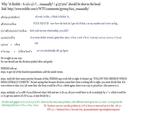
![Best Answer - Chosen by Voters atics is supposed to provide you with single, definitive answers. However, in Mathem this case, it does not. I really scoured the internet and countless textbooks for the Phyxiusproper answer and have made inquiries with few people I know whom I venerate as AEnimus some of the greatest minds that I have had the luxury of meeting and the answer isn't as definitive as you would hope. Sadly, the real answer is that both sides are correct to a point. (...and it pains me to even remotely admit that anything outside of 288 could be the answer). Position 1: The Order of Operations: This stance states that since the standard order of operations puts multiplication and division on the same rank, the equation can be read as (48 2)(9+3). This reigns with truth as 48+2(9+3) is the same as 48+2*(9+3). Using the standardized left-to-right notation, the answer can be nothing outside of 288. This left-to-right concept is indicative of "PEMDAS" that we all learned in grade school Position 2: The Distributive Property: This stance states that multiplication through juxtaposition, being a commonplace concept, naturally makes a parenthetical implication around grouped numbers. Thus, the equation appears as 48+[2(9+3)]. This technique is correct as well. However, this mak es the answer 2.](https://i.kym-cdn.com/photos/images/list/000/574/344/ec1.png "ec1.png")
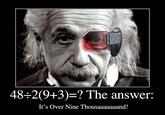

48÷2(9+3) = ?
Part of a series on Viral Math Problems / Math Bait. [View Related Entries]

About
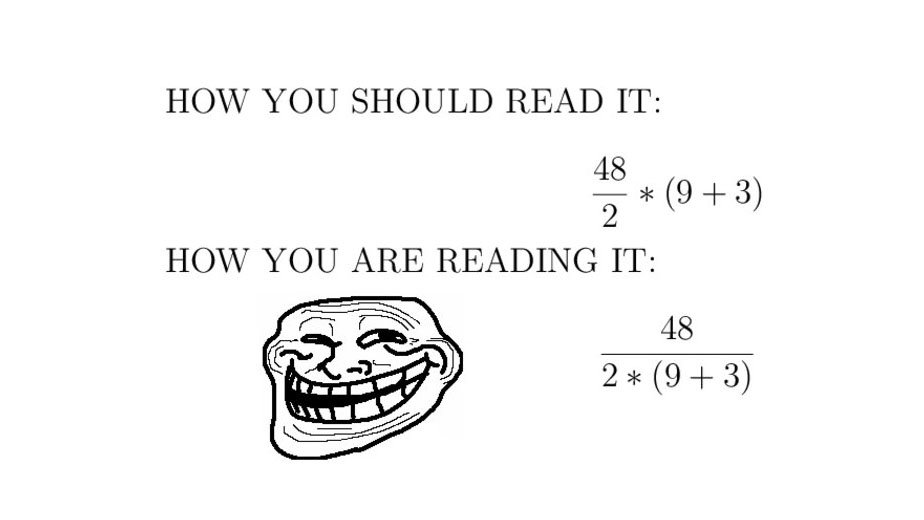
48÷2(9+3) = ? is a math problem that leads to two different answers depending on the order of operations[1] used. Since 2011, message board users have debated over whether 2 or 288 is the correct answer to the problem, with no conclusive answer. This and another seemingly impossible equations have been a hot topic of forum debate that are sometimes used to troll other posters who will vehemently argue that their answer is the definitive one.
Origin
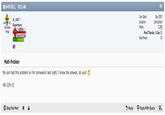
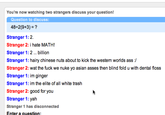
On April 7th, 2011, a user of the local Texas message board Hot Pursuit[3] known as al_carl polled other users about the equation 48÷2(9+3), found in his son's homework the previous night. He offered four different answers, 2, 3.14, 219 and 288. The answers were relatively evenly split, with 50 people choosing 2 and 55 choosing 288. The question generated 95 replies of debate about the correct answer.

Spread
Later that day, someone reposted the equation to the Bodybuilding.com message board[4], where more than 2,500 replies were posted. Also on April 7th, debate about the equation took place on dozens of message boards, ranging from communities surrounding broad topics to fan spaces for local sports teams including the Physics Forums[5], Wall Street Oasis[6], MSU Red Cedar[7], Grass City[8], Tennis Warehouse[9], Inside MD Sports[10] and The Ecapist.[11] Later that day, the equation was posed on Yahoo! Answers[11], where the user Phyxius Ænimus broke down the two approaches to the problem, noting that sometimes math does not provide definitive answers.
![Best Answer - Chosen by Voters atics is supposed to provide you with single, definitive answers. However, in Mathem this case, it does not. I really scoured the internet and countless textbooks for the Phyxiusproper answer and have made inquiries with few people I know whom I venerate as AEnimus some of the greatest minds that I have had the luxury of meeting and the answer isn't as definitive as you would hope. Sadly, the real answer is that both sides are correct to a point. (...and it pains me to even remotely admit that anything outside of 288 could be the answer). Position 1: The Order of Operations: This stance states that since the standard order of operations puts multiplication and division on the same rank, the equation can be read as (48 2)(9+3). This reigns with truth as 48+2(9+3) is the same as 48+2*(9+3). Using the standardized left-to-right notation, the answer can be nothing outside of 288. This left-to-right concept is indicative of "PEMDAS" that we all learned in grade school Position 2: The Distributive Property: This stance states that multiplication through juxtaposition, being a commonplace concept, naturally makes a parenthetical implication around grouped numbers. Thus, the equation appears as 48+[2(9+3)]. This technique is correct as well. However, this mak es the answer 2.](https://i.kym-cdn.com/photos/images/newsfeed/000/574/344/ec1.png "ec1.png")
The next day, additional discussions of the equation took place on the Sneaker Talk forums[12], Yahoo! Answers Australia[13] and DIY Mobile Audio.[14]
Solution
The reason different calculators offer different answers to the equation depends on how the machine interprets the order of operations. Most calculators follow the traditional order, completing expressions within brackets before anything else, resulting in an answer of 288, as determined by WolframAlpha[17] and Google.[18] In this case, the problem is solved as follows:
48 ÷ 2(12)=
(48 ÷ 2)(12)=
24 * 12=
288
However, others will follow PEMDAS, a mnemonic term that stands for Parentheses, Exponentiation, Multiplication, Division, Addition and Subtraction. By this logic, multiplication must take place before division, resulting in solving the problem as follows:
48 ÷ 2(12)=
48 ÷ 24=
2
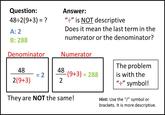
Order of Operations and PEMDAS are not the only rules that can be applied to complete the equation. If one applies the distributive property, which requires numbers outside of an equation in parentheses be multiplied to each number in the enclosed equation separately, both results of 2 and 288 can be observed, depending on whether or not the division takes place first.
48 ÷ (2(9)+2(3))= (distributive property)
48 ÷ (18 + 6)=
48 ÷ 24=
2
(48 ÷ 2)(9+3)=
24(9 + 3)=
24(9) + 24(3)= (distributive property)
216 + 72
288
There is also an argument[15] that implied multiplication, as seen in the algebraic phrase 2x takes precedence over explicit multiplication using the "x" symbol. For example, in the problem 2/5x, the implicit multiplication suggested by 5x would come before the explicit division of 2/5. Following this logic, the equation can be solved as follows:
48 ÷ 2(12)=
48 ÷ 24=
2
The final approach suggests the obelus, the term for the symbol "÷", represents the division of all terms preceding it by all terms after it[20][21], separating the two components of the equation at hand. Using this interpretation, the equation is solved like so:
(48) ÷ (2(9+3))=
(48) ÷ (2(12))
(48) ÷ (24)
2
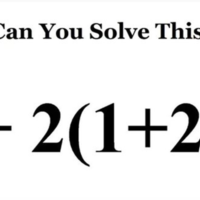
Related Problem: 6÷2(1+2)= ?
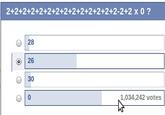
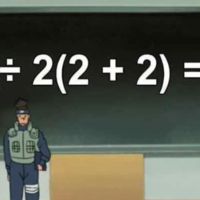
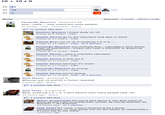
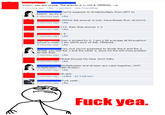
On April 27th, 2011, Redditor and math professor rob1n posted an image macro to the /r/WTF subreddit[16] featuring a screenshot of a Facebook poll debating the answer to variation of this equation, 6÷2(1+2), which results in the answers of 1 or 9. Within two days, it received more than 1,200 comments, gaining more than 2,500 upvotes and 786 points overall. Throughout April and May, this equation was discussed on Yahoo! Answers[17], IGN[22] the Wolfram Alpha Community Forum[24], and the Penny Arcade forum.[25] The equation saw a resurgence in early 2013, resulting in discussions on Snopes[26] and Slate[27], who investigated why people get so worked up over the differing answers.

Click through to see entire image
Search Interest
External References
[1] Wikipedia -- Order of Operations
[2] “48÷2(9+3) =” -- Search results
[3] Hot Pursuit -- Math Problem (requires login)
[4] Body Building – 48÷2(9+3) = ???? / 4/07/2011
[5] Physics Forums – 48÷2(9+3) equation / 04/07/2011
[6] Wall Street Oasis – 48÷2(9+3) equation / 04/07/2011
[7] MSU Red Cedar Message Board – 48÷2(9+3) = ???? / 04/07/2011
[7] Grass City – 48÷2(9+3) = ???? / 04/07/2011
[8] Tennis Warehouse – 48÷2(9+3) = ?? / 04/07/2011
[9] Inside MD Sports – 48÷2(9+3) / 04/07/2011
[10] The Escapist – Poll: What is the answer to 48/2(9+3)? / 04/07/2011
[11] Yahoo! Answers – 48÷2(9+3)? BEDMAS gives 288 but PEMDAS gives 2? / 04/07/2011
[12] Sneaker Talk – 48÷2(9+3) = ??? / 04/08/2011
[13] Yahoo! Answers Australia – 48/2(9+3)…………………… / 04/08/2011
[14] DIY Mobile Audio – 48÷2(9+3) / 04/087/2011
[15] Mathematics Stack Exchange – There is no order difference between implicit and explicit multiplications
[16] Reddit – 6÷2(1+2)=?…. reaaaaally? / 4/27/2011
[17] Yahoo! Answers – 6÷2(1+2)= ? is it 1 or 6?
[19] Google – Calculated Answer
[20] Tribal War – Whimsical's Post / 04/12/2011
[21] NikeTalk – Obelus Discussion
[22] IGN – Goddamit people! 6/2(1+2) is 9. How f****** hard could it be?!
[24] Wolfram Alpha Community Forum – Evaluation of 6÷2(1+2)
[25] Penny Arcade Forum – 6/2(1+2)=SOLVED
[26] Snopes – The Answer is 9. Really, it's 9
[27] Slate – What Is the Answer to That Stupid Math Problem on Facebook?













Comments ( 506 )
Sorry, but you must activate your account to post a comment.
Please check your email for your activation code.