


Moe
Part of a series on Otaku. [View Related Entries]
[View Related Sub-entries]
About
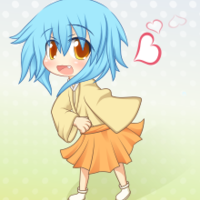
Moe is a Japanese slang term used to describe one's feeling of attraction towards a specific type of anime, manga or videogame character. It also refers to the subculture within anime fandom that deals with moekko, which means "adorable" or "cute" characters.
Origin
The etymology of the term "moe" remains unknown and disputed. One of the more prominent theories behind the term's origin points to the Japanese word for "budding," as with a plant that is about to flower. According to Nomura Research Institute's Ken Kitabayashi, the slang term is a pun with the Japanese verb for "to sprout" ( (萌える, moeru) and its homonym "to burn" (燃える, moyasu), in the sense of one's heart burning with passion.
Another theory asserts that its usage stems from 2channel in the 1990s when the word was used to refer to female characters who were "hybrids of the Lolicon (lolita complex) and bishoujo (beautiful girls) genres," Hotaru Tomoe from Sailor Moon being an early example of a moekko character.
In an article written by Patrick W. Galbraith of Tokyo University [1], Galibraith explores the origins and meanings behind the term "moe". He states that the term originated from 2channel in the 1990s in the discussion of young, cute, and innocent girls and their burning passion for them. This term likely picked up because moeru (nominalized as moe) while meaning 'to bud or sprout,', is homophonous with the verb 'to burn.'
The sexualization of underage (or underage-looking) characters in manga goes back to the late '70s, when underground and adult manga artists such as Disappearance Diary creator Hideo Azuma began to work around censorship laws by drawing characters without pubic hair. This was the beginning of the lolicon (Lolita Complex) trend;
Spread
However, typically in use "moe" generally means what an individual finds to be appealing or cute. It is not limited by gender or even necessary limited to living things, though a degree of personification is typically necessary for something to be considered moe and it is not uncommon for people to put human traits on non-human subjects to achieve a "moe" effect. (see Gijinka)
While the term can be associated with romantic love for the character, it can also refer to having pure and platonic love for a character.
Most often though, moe characters are young female characters. However, even characters like Kaiji Itou have been considered "moe" at one point.
Common Moe Archetypes
While many of these are associated with personality, there are also many physical characteristics typically owned by characters designed to be "moe". Moetron and other fan-made chimera characters are meant to make fun of how common these characteristics are.
- Megane (glasses wearing characters)
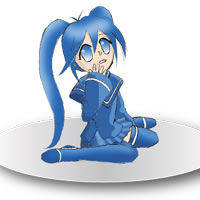
- Twin tails (see Hatsune Miku), and drill hair
- Loli (young or youthful looking girls)
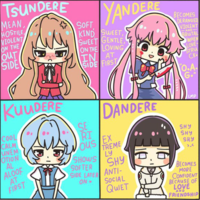
- Tsundere
- Kuudere (cool and apathetic type, often portrayed as robotic)
- Maid
- Cat girls, girls with fangs
- Plain girl
- Imouto (little sister)
- Energetic girl
- Clumsy girl
- Ahoge (アホ毛, antenna-like hair that sticks up)
Moe Sangyo
In particular, a lot of attention has been brought to anime series using "moe" characters to ensure that a series sells. It is very similar to the concept of western media using sex appeal to promote franchises. Some fans are all right and actually prefer shows of this type, while others automatically dismiss a show if it is using "moe" to draw in appeal. This particular topic of "moe is the cancer killing anime" is something that's even discussed among Japanese fans. (See GAR)
Moe sangyo (萌え産業?) literally means "budding business," and refers to the current[citation needed] boom in entertainment industries relating to otaku-primarily anime, manga, and video games. The word "moe" literally means "budding" or "sprouting," but has come in otaku culture to refer to a crush, fetish, or infatuation with a specific character or subject, usually involving cute young girls or young boys. Moe can be used as an adjective, noun, or an exclamation, similar to "kawaii."
Moe Anthropomorphism

One other phenomena is the personification of non-human objects. A popular fad among corporations lately has been to create selling points for products by using anime characters or even creating moe mascot characters based off of different products. Most of it starts out as fan art, but some of these things are adopted or created by corporations.
These kinds of mascots are popular in otaku culture and they are frequently seen on many websites including, but not limited to 2channel, Futaba Channel (2chan), 4chan, pixiv, deviantART and Nico Nico Douga.
External References
[1] Japanese Studies – Moe, Exploring Virtual Potential in Post-Millennial Japan
Related Entries 16 total

Waifu |

Weeaboo |

Girugamesh |

Dakimakura / Waifu Body Pillow |
Dinner with Waifu / Otaku Dates |
Otaku Test |
Pantsu |

Katana |

Buruma |
Itasha |
Baka |

Kawaii |










Top Comments
Myconix
Feb 16, 2013 at 02:51AM EST
Maiden Heaven
May 09, 2013 at 01:44AM EDT