


Trolling / Troll

Confirmed 1,224,409
Part of a series on Internet Slang. [View Related Entries]

Trolling / Troll
Part of a series on Internet Slang. [View Related Entries]
[View Related Sub-entries]
This entry contains content that may be considered sensitive to some viewers.
About
Troll or Trolling is a slang term used to describe any internet user or their behavior that is meant to intentionally anger or frustrate someone else, though not to be confused with cyberbullying, a form of online harassment carried out against an individual in a deliberately hostile manner (often without any reason) or pranking, which similarly involves playing jokes on strangers for one's amusement (but typically implies more coordination and intent).
Online History
Etymology
The etymological root of the word "troll" is generally attributed to hunting and fishing jargon. According to the Online Etymology Dictionary[8], the noun "troll" originated from an Old Norse word for a type of monstrous creature and the verb to troll comes from the Old French hunting term "troller." According to Merriam-Webster[9], the English verb to troll refers to the act of slowly dragging a lure while fishing as bait.
In Other Languages
In Japanese, tsuri (つり) means "fishing" and refers to intentionally misleading posts created with the purpose of eliciting negative response from other users. Arashi (あらし) means "laying waste" and can also be used to refer to simple spamming. In Korean, nak-si (낚시) means "fishing," and is used to refer to Internet trolling attempts, as well as purposefully misleading post titles. A person who recognizes the troll after having responded (or, in case of a post title nak-si, having read the actual post) would often refer to himself as a caught fish.
Early Usage
The contemporary use of the term is alleged to have appeared on the Internet in the late 1980s, but the earliest known mention of the word "troll" on record can be found in a post on the Usenet newsgroup alt.folklore.urban from December 14th, 1992. The term continued to grow popular in the early 1990s through its usage in the Usenet group alt.folklore.urban and by the late 1990s, the alt.folklore.urban newsgroup had such heavy traffic and participation that acts of trolling became frowned upon. Prior to the widespread use of the term "trolling," similar behaviors have been observed through "griefing," the act of intentionally causing distress to other players in an online game, since the days of Multi-User Dungeons (MUDs) in the late 1980s and "flaming," the act of instigating hostility or unpleasant exchanges in online forums, which also emerged through Usenet newsgroup discussions.
The Rules of the Internet
The Rules of the Internet is a list of protocols and conventions, originally written to serve as a guide for those who identified themselves with the Internet group Anonymous. By looking at the Rules of the Internet, one can understand the patterns of behaviors behind anonymous trolls:
- Rules 8 and 9 describe the free-for-all environment of anonymous interactions on 4chan:
8.There are no real rules about posting.
9.There are no real rules about moderation either – enjoy your ban.
- Rules 11-15 describe exactly what one can expect when confronting a troll:
11.All your carefully picked arguments can easily be ignored.
12. Anything you say can and will be used against you.
13. Anything you say can be turned into something else – fixed.
14. Do not argue with trolls – it means that they win.
15. The harder you try the harder you will fail.
- Rules 18 and 19 reinforce the presence of trolls and the nihilism behind the trolling behavior:
18. Everything that can be labeled can be hated.
19. The more you hate it the stronger it gets.
- Rule 20 is perhaps the most important rule of all and best defense against trolls:
Rule 20. Nothing is to be taken seriously!
- Rule 39 is an example of some good-natured trolling. The annoyance caused by CAPSLOCK is widely recognized, so to say that it is “cruise control for cool” is one of the few instances that sarcasm is able to carry over to text without much effort:
39. CAPSLOCK IS CRUISE CONTROL FOR COOL
- Rule 42 and 43 are statements that apply not only to the motivation behind trolls, but also to a warped sense of catharsis that some have experienced through observing trolls:
42. Nothing is Sacred
43. The more beautiful and pure a thing is – the more satisfying it is to corrupt it.
Trollface
Trollface is a black and white drawing of a face with a large mischievous grin that is meant to portray the expression someone makes while trolling. Posting a Trollface image into a forum thread is often used to claim that someone was being fooled or intentionally angered. The face commonly appears in rage comic indicating that the character is being mischievous in some way. The original drawing was created by deviantArt[1] user Whynne on September 19th, 2008 to illustrate the pointless nature of trolling on 4chan’s /v/ (videogames) board.

Online Usage
Trolling is most commonly associated with online discussions where users are subjected to offensive or superfluous posts and messages in order to provoke a response. Numerous forums and Usenet boards are dedicated to the fine art of what the New York Times[10] called "manipulating other people's emotional equilibrium." Trolling can be considered a form of cyberbullying and. For more information, Wikipedia[2] offers a consistently updated summary of research[5] behind the human motivation to troll.
Griefing
Griefing is the act of intentionally causing distress to other players in an online game. The tactics used to cause grief vary depending on which game is being played. Griefers sometimes record their victim’s reactions and upload the videos onto YouTube.

Flaming
Flaming, though not strictly limited to intentional acts of trolling, is another popular method of instigating hostility or unpleasant exchanges in online discussions by bringing up incendiary subject topics like the September 11th attacks, Religion, Politics and Sexism. Early incidents of trolling were considered to be the same as flaming, but this has changed with modern usage by the news media to refer to the creation of any content that targets another person.

Raiding
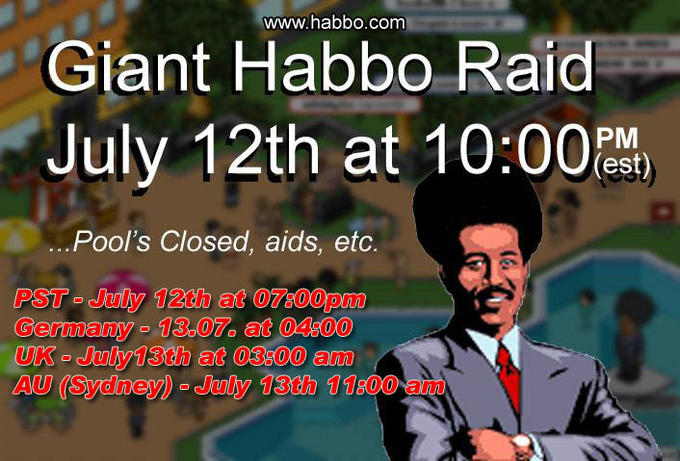
Raiding, or the act of coordinating a group assault on a massive scale, is a popular choice of method for Internet trolls, especially those associated with Anonymous on 4chan. Prime examples include Tom Green's Call-in Talk Show Raid, Habbo Hotel Raid, Operation YouTube, Club Penguin Raid, Put Shoe On Head and Ventrillo Harassment among others.
Shock Trolling
Shock trolling is a common tactic practiced by exposing the targeted victim to disturbing or shocking content, such as materials from shock sites, horror or pornographic images, in order to provoke a strong reaction. To an extent, shock value trolling has been demonstrated in real life as practical jokes like The Scary Maze Game and Scary Prank Reaction Videos.

Bait and Switching
Bait-and-Switch is a common tactic associated with online fraud and practical humor that involves falsely advertising a hyperlink as a destination of interest, when in fact, it leads to something that is irrelevant or undesirable.
Misleading Hyperlinks
Some of the most commonly linked destinations in bait-and-switch trolling include The Hampster Dance, Duckroll, Rickroll, Trololol, Nigel Thornberry Remix and Epic Sax Guy. The method is also widely used as an online prank wherein links to shock sites and media are falsely advertised as news or information that is in high demand.

An Example of a Rickroll Hyperlink (click through for more info)
Copypasta Stories
On 4chan, bait-and-switch trolling has also demonstrated its use as a plot device in greentext stories, copypastas and creepypastas, in which the OP begins by telling a story that seems believable enough to be autobiographical or confessional, but as the narrative progresses, it is brought to a sudden and anti-climactic end with an excerpt of a widely recognized quote or pop song lyrics. Some of the most notable examples include Fresh Prince of Bel-Air, Spaghetti Stories, Tree Fiddy and Burst into Treats among others.


Advice Trolling
Advice Trolling is yet another common method used to mislead people by offering dubious or sometimes malicious advices, especially to newbies who are less experienced and more gullible than others. Prime examples include Download More RAM, Delete System 32 and Alt + F4.
![□ Anonymous 10/15/10(Fri)00:41:19 No.279648XXX [Reply] DELETE SYSTEM32 As a former worker at Microsoft Inc. I and lots of others know that a file in every windows OS called "system32" What system32 is, is something that saves snapshots, history, and bookmarks of internet explorer and Netscape. This makes Microsoft know how to improve it's web experience. To get rid of system32 for why every reason, just open "my computer" or "computer" from the start menu and search in the top right corner "system32" and wait for EVERYTHING to load. Then, select all the files and folders named "system32" and simply delete them from windows. WARNING, DOING THIS COMPLETELY CLEARS YOUR BROWSING HISTORY 39 posts and 3 image replies omitted. Click Reply to view □ Anonymous 10/15/10(Fri)01:01:41 No.279653XXX MAKE YOUR PC FASTER ok can somebody please help me like just for 5 mins to get this laptop running again please my gf gunna be so p----- at me □ Anonymous 10/15/10(Fri)01:02:32 No.2796530X 279652975 Well I feel as if newfags deserve the best and harmless information they can get so there computer can run 4chan even better! □ Anonymous 10/15/10(Fri)01:03:08 No.2796530X 279653169 did you delete ALL of it? cuz if you only partially delete it gets real slow, because comp looks for the missing files. if it's ALL gone, then it doesn't even try, and s--- just flies Captcha: Mario prevailed Internet 105%](https://i.kym-cdn.com/photos/images/newsfeed/000/077/443/untitled.JPG "untitled.JPG")

Newbie Trolling
As its name suggests, newbie trolling, is the act of instilling hostility and annoyance by posing as an inexperienced newcomer and posting redundant questions to solicit reactions from those who're more experienced and genuinely willing to help. The tried-and-true practice of "playing dumb" has been also observed in the form of grammar trolling, which entails intentionally misspelling a word or a phrase in order to solicit reactions or corrections from those unable to tolerate faulty grammar, sometimes known as Grammar Nazis.

Snipe Hunting
- Snipe Hunting, also known as "a fool's errand," is yet another popular type of trolling that involves tricking newbies into go on a search for something that does not exist. Some examples include Headlight Fluid, Gold Membership Trolling, Battletoads Preorder and Download More RAM among others.

Concern Trolling
- Concern trolling is the practice of initiating a false flag debate by assuming the exact opposite point of view as the one actually held by the speaker. The purpose of concern trolling is to instill confusion and doubt within the targeted group by raising issues under the pretext that the speaker empathizes with the said group.

Related Controversies
PairGain Speculation
On April 8th, 1999, several investors were tipped off by trolls in Yahoo Finance chat rooms that the California-based telephone equipment company PairGain was soon to be acquired by an Israeli telecom company. As a result, PairGain’s stock jumped by 31% at one point, though it promptly crashed after the initial reports were identified as a hoax started by a former PairGain employee.
Oklahoma Bombing T-shirt
On April 25th, 1995, six days after the Oklahoma City bombing, anonymous Internet users began posting advertisements for t-shirts and merchandises glorifying the bombing of the federal building onto AOL's Michigan Military Movement bulletin board. The messages instructed the readers to call Kenneth M. Zeran, a man who had nothing to do with the ads or the merchandise aside from the fact that his phone number was included in the message. Shortly after the posting of the messages, Zeran began receiving a barrage of threatening calls.
The Case of Jessi Slaughter
Jessi Slaughter, real name Jessica Leonhardt and formerly known as KerliGirl13[1] on YouTube, is a Florida teenager whose attention-seeking behaviors in her YouTube videos caused her to become the target of a 4chan raid, resulting in a rage-fueled and ill-advised retort from her father that became the subject of image macros and remix videos. As a result, a police investigation was initiated by the local sheriff's department to supposedly track down the pranksters.
The Case of Natasha MacBryde (UK)

On September 14th, 2011, Sean Duffy, a 25 year old British man from Reading, Berkshire was sentenced to eighteen weeks in jail after pleading guilty to "two counts of sending a communication of an indecent or offensive nature." Months earlier, Duffy had left inappropriate videos and messages on the Facebook memorial page for Natasha MacBryde, a 15 year old girl who committed suicide after receiving anonymous messages on her Formspring page and having an argument with a friend via Facebook[7], similar to the plot of the ABC Family movie Cyberbully.

On September 15th, the British news agencies Telegraph[12] and BBC[6] reported that Duffy was accused of posting similar videos and messages on another Facebook memorial tributes page for Sophie Taylor, a 16 year old girl who was accidentally shot dead by her boyfriend.
Studies
Identity & Deception in Virtual Communities
The earliest known academic research on the practice of internet trolling was conducted by MIT media scholar Judith Donath in her 1996 paper "Identity and Deception in the Virtual Community." From Wikipedia[2]:
"In the physical world there is an inherent unity to the self, for the body provides a compelling and convenient definition of identity. The norm is: one body, one identity … The virtual world is different. It is composed of information rather than matter.”
“Trolling is a game about identity deception, albeit one that is played without the consent of most of the players. The troll attempts to pass as a legitimate participant, sharing the group's common interests and concerns; the newsgroups members, if they are cognizant of trolls and other identity deceptions, attempt to both distinguish real from trolling postings, and upon judging a poster a troll, make the offending poster leave the group. Their success at the former depends on how well they – and the troll – understand identity cues; their success at the latter depends on whether the troll's enjoyment is sufficiently diminished or outweighed by the costs imposed by the group.”
Psychology Behind Trolling
From Wikipedia[2]:
Some psychologists have suggested that flaming would be caused by de-individuation, or decreased self-evaluation: the anonymity of online postings would lead to disinhibition amongst individuals. Others have suggested that although flaming and trolling is often unpleasant, it may be a form of normative behavior that expresses the social identity of a certain user group. According to Tom Postmes, a professor of social and organisational psychology at the universities of Exeter, England, and Groningen, The Netherlands, and the author of Individuality and the Group, who has studied online behavior for 20 years, "Trolls aspire to violence, to the level of trouble they can cause in an environment. They want it to kick off. They want to promote antipathetic emotions of disgust and outrage, which morbidly gives them a sense of pleasure."
Understanding Trolls
On August 3rd, 2008, New York Times[10] explored the history behind the online phenomenon of trolling in an article titled "The Trolls Among Us."
In the late 1980s, Internet users adopted the word “troll” to denote someone who intentionally disrupts online communities. Early trolling was relatively innocuous, taking place inside of small, single-topic Usenet groups. The trolls employed what the M.I.T. professor Judith Donath calls a “pseudo-naïve” tactic, asking stupid questions and seeing who would rise to the bait. The game was to find out who would see through this stereotypical newbie behavior, and who would fall for it. As one guide to trolldom puts it, “If you don’t fall for the joke, you get to be in on it.”
In the article, James Fortuny, a central figure behind Megan Meier's posthumous trolling controversy, explained the concept of trolling and how it can be stopped:
Fortuny: “You have green hair. Did you know that?”
Mattathias: “No,”
Fortuny: “Why not?”
Mattathias: “I look in the mirror. I see my hair is black.”
Fortuny: “That’s uh, interesting. I guess you understand that you have green hair about as well as you understand that you’re a terrible reporter.”
Mattathias: “What do you mean? What did I do?”
Fortuny: “That’s a very interesting reaction. why didn’t you get so defensive when I said you had green hair?” If I were certain that I wasn’t a terrible reporter, he explained, I would have laughed the suggestion off just as easily. The willingness of trolling “victims” to be hurt by words, he argued, makes them complicit, and trolling will end as soon as we all get over it.
Trolls Just Want to Have Fun
On February 8th, 2014, University of Manitoba's Erin Buckels and two of her colleagues published a psychology paper[15] on the personalities of trolls on the Internet. According to Slate's summary[17] of the paper, Buckels tried to investigate whether people who are prone to engage in trolling can be characterized by certain personality traits that would fall in what the researchers refer to as the Dark Tetrad, Machiavellianism (willingness to manipulate and deceive others), narcissism (egotism and self-obsession), psychopathy (the lack of remorse and empathy), and sadism (pleasure in the suffering of others). According to the paper, their study found significant correlations between exhibition of sadistic traits and trolling behavior.

Search Interest
External References
[1] Penny Arcade – Green Blackboards (And Other Anomalies)
[2] Wikipedia – Troll (Internet)
[4] Wikimedia – What is a troll?
[5] Wikipedia – Published Research on Trolling
[6] BBC News – Sean Duffy case highlights murky world of trolling
[7] BBC News – Natasha MacBryde: Rail death teen threatened online
[8] Online Etymology Dictionary – troll
[10] New York Times – The Trolls Among Us
[11] OED – troll (page unavailable)
[12] Telegraph via Way Back Machine – Loathsome though they are, Internet 'trolls' should not be sent to prison
[15] ScienceDirect – Trolls just want to have fun
[16] MotherJones – New Study: Internet Trolls Are Often Machiavellian Sadists
Related Entries 545 total

The Mandela Effect |

Derp |

Wat |

Ayy LMAO |

Kek |

Fap |

Cool Story, Bro |

Karen |

I Accidentally |

Dafuq |

I See What You Did There |

Your Argument Is Invalid |
Sub-entries 38 total







Recent Videos 113 total






Recent Images 545 total


Share Pin








Top Comments
TripleA9000
Jan 06, 2014 at 03:13PM EST
RockoRocks
Jun 19, 2013 at 09:50AM EDT